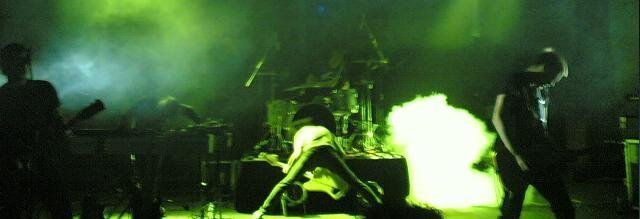
Esta vem por sugestão na caixa de comentários. E vem bem bem. Ora vejam:
"(...)
E qual é a sua conexão com o pessoal do ATP? Você é algum tipo de conselheiro?
Não exatamente. Sou amigo há bastante tempo do Barry e da Debbie, as pessoas que organizam o ATP, e temos uma antiga associação com o festival. Tocamos no segundo ano, e depois fomos curadores de outra edição. Nós tocamos basicamente todas as vezes que eles nos convidam. O ATP é de fato notável. Eles mudaram a maneira como os festivais funcionam, no mundo inteiro. Antes do ATP os festivais eram desses eventos deploráveis só voltados para o lucro, e todas as bandas associadas que tocavam o faziam por alguma razão estranha voltada para o lucro. Ninguém realmente achava que os festivais tinham alguma personalidade. Era somente um caminho para fazer dinheiro fácil durante uma turnê. Ou bandas menores que não eram muito conhecidas usavam os festivais como uma forma de gerar algum interesse na banda, e eles ainda eram obrigados a pagar para tocar em alguns desses festivais. A coisa toda era institucionalizada e bastante desagradável. O ATP de fato mudou tudo. Ter uma banda escolhendo outras bandas, como curadores endossando as outras bandas, e tendo o dinheiro distribuído de uma maneira igualitária entre as bandas, e tendo as bandas e os patrocinadores convivendo juntos de uma maneira mais social… é totalmente único. Isso realmente mudou a maneira como os festivais são organizados. Como o ATP teve sucesso fazendo isso, todos os outros festivais tiveram que melhorar e providenciar uma maior variedade de artistas. Tiveram que tratar melhor as bandas, serem mais igualitários na maneira como as bandas e os patrocinadores são tratados. Eles realmente forçaram outras pessoas a competirem com eles. Tenho muito respeito por isso.
(...)
Você mencionou algo sobre bandas pagarem para tocar em festivais. Nós temos uma grande discussão no Brasil, de bandas que bancam para tocar em festivais, enquanto outras acham isso errado.
Isso é utópico. Um festival deve ser organizado de uma forma que bandas que as pessoas gostariam de ver são apresentadas para as pessoas que gostariam de ver as bandas. Se alguém está pagando para tocar significa que existe um critério diferente envolvido, e instantaneamente me faz suspeitar do festival. Me faz achar que há algo fundamentalmente errado. Não necessariamente acho que as bandas que estão pagando para tocar estão fazendo algo errado, só estão fazendo algo tolo. Mas não coloco alguma consideração moral ou ética nisso. Acho que elas estão fazendo algo tolo porque elas estão pagando por algo que elas deveriam estar recebendo. E elas também estão se apresentando para um público que não gosta delas o suficiente para pagar. Então elas estão fazendo um show que talvez não valha a pena fazer, gastando dinheiro pelo privilégio de fazer um show que não vale à pena. É tolo, mas não necessariamente algo eticamente ou moralmente errado. Quem promove, o pessoal que está aceitando esse dinheiro, estes sim estão fazendo algo eticamente errado.
(...)
O que você acha de jornalismo musical? Eu estava lendo o fórum do Electrical Audio e vi um post seu com opiniões bem fortes sobre o tema.
Bem, o problema com jornalismo musical é que ele é publicado em um jornal como se fosse jornalismo de verdade, mas no qual os padrões profissionais do jornalismo não se aplicam. Em um artigo normal, se um repórter publica algo fundamentalmente incorreto, como o nome do prefeito ou de um esportista famoso, ele é demitido. Não é aceitável no jornalismo convencional encontrar fatos simples apresentados de maneira errada. No jornalismo musical, ninguém se importa. Você pode publicar um monte de coisas erradas e só rola um: “ok, não tem problema, não importa”. Não é levado a sério. Jornalismo musical não é levado a sério como jornalismo nem pelas pessoas que o praticam, nem pelas publicações que o usam. Então, um monte de informação errada é publicada e acaba virando registro histórico. Se alguém escreve algo incorreto em um jornal ou em um website e depois dez outros jornais ou websites fazem referência a essa informação errada, isso se transforma em algo inconcreto, e dali para frente vira história. E eu acho isso terrível, porque existe jornalismo de verdade que poderia ser feito. Tem um monte de assuntos que tem a ver com música. Por exemplo, o que você descreveu, de bandas pagarem para tocar em festivais, ou festivais aceitando dinheiro do governo e sendo tão ineficientes que não podem pagar as bandas, isso são pautas para jornalismo de verdade. Alguém deveria escrever sobre isso. O público de música se interessaria por isso. Poderia ser jornalismo de verdade. Mas ninguém está escrevendo esses artigos. Ao invés disso eles estão escrevendo coisas como o que essa pessoa está vestindo, ou que tipo de maquiagem esse outro está usando, quem está namorando com quem ou quem usa drogas, essas coisas. Isso é merda, pura merda. E mesmo nessa área limitada de merda, jornalistas musicais podem publicar erros fundamentais que ninguém se importa.
Eu tenho amigos jornalistas e o que eles dizem de publicar artigos estúpidos, como o que as pessoas vestem, acabam tendo mais leituras. Eles acompanham os links nos sites e portais e esses artigos são sempre os mais lidos. As pessoas realmente querem saber o que os outros estão vestindo.
Não existe nenhuma lei que diz que jornalismo deve ser feito para as pessoas mais estúpidas do mundo. Se o seu jornalismo é feito para atrair o máximo de pessoas de algum tipo para lerem o que você escreve, então não há razão para fazer algo específico em música. Porque se você escrever sobre outra coisa, então mais pessoas vão ler. Se você escrever sobre a Copa do Mundo, mais pessoas vão ler do que sobre música, então por que você está escrevendo sobre música? Se você decidiu que quer escrever sobre música, essa é uma decisão sua não baseada no que é mais popular. Então você tem uma obrigação de levar isso a sério, porque você escolheu escrever sobre música. O argumento de que isso é mais popular, “é isso que as pessoas gostam”, não significa nada para mim. Porque o que é popular, o que as pessoas gostam, é de McDonald’s, Coca-Cola. Isso é popular. Mas não é necessariamente a melhor coisa para comer ou beber. E se você escrever sobre comida, talvez você deva escrever sobre as melhores comidas que as pessoas podem comer ou beber, ou dizer que tipo de problema elas teriam se elas só comessem McDonald’s e tomassem Coca-Cola.
(...)"
Mostrar mensagens com a etiqueta Entrevista. Mostrar todas as mensagens
Mostrar mensagens com a etiqueta Entrevista. Mostrar todas as mensagens
terça-feira, outubro 12, 2010

segunda-feira, outubro 11, 2010
Não se pode dizer que o Trent Reznor seja preguiçoso
Bem pelo contrário, o homem vai ficando velho, mas tem a energia de lâmpada eléctrica. Piadas parvas e inventadas agora de parte, não é só a tal banda sonora para o filme sobre a tal rede social que o Trent Reznor tem feito. Fê-lo, é verdade, e fê-lo muito bem.
Mas, sobre isso, tem dado entrevistas (como ESTA) e mostrado o seu charme da melhor maneira possível.
E não só! Ainda conseguiu convencer a HBO de que Year Zero era uma história do arco da velha! Ou seja, teremos uma mini-série sobre o tema do álbum, o que me parece fantástico. Principalmente porque, deste blogue, acompanhei o fenómeno como alguém que não tenha mais nada para fazer faria. Escrevi mesmo algo a resumir a situação da altura AQUI (sim, dou-me ao luxo de me citar a mim mesmo. Posso desculpar-me com Hitchcock?).
sexta-feira, outubro 08, 2010
Entrevista a Steve Albini
A coisa foi feita na GQ e tem um título fantástico: Punk Pioneer Steve Albini on Music Festivals, The Future of Radio and Why He Wants GQ To Fail.
Parece-me muito bem e a coisa está toda disponível AQUI.
Façam bom proveito.
quarta-feira, janeiro 27, 2010
Entrevista a Toby Driver (Kayo Dot)
Depois de alguma inactividade (damn you, exames!), acho que me posso dizer orgulhoso de re-arrancar com o arremesso de postas através de um bicho desta envergadura:

“Cada álbum que faço é como uma viagem” - Toby Driver em entrevista ao Ponto Alternativo
As verdades, agora comprováveis por muita gente: o Toby é um tipo de pés no chão, humilde, mas com tanta a coisa a passar-se naquela cabeça que nos reduz simpaticamente a um pontozinho - e sem consciência de o fazer. É uma boa pessoa que faz música brilhante.
Nesta entrevista, ele explica-nos sucintamente o seu trabalho, tanto a nível musical, com os Kayo Dot, com os Tartar Lamb e mesmo com os Maudlin, como a nível visual, com a produção do artwork de cada álbum. A experiência em Portugal está presente e, o mais importante, desvenda-nos alguns pormenores sobre o próximo álbum, COyote. Espero que gostem tanto de a ler como eu gostei de a fazer. Foi uma das horas mais ricas dos meus últimos meses.

“Cada álbum que faço é como uma viagem” - Toby Driver em entrevista ao Ponto Alternativo
As verdades, agora comprováveis por muita gente: o Toby é um tipo de pés no chão, humilde, mas com tanta a coisa a passar-se naquela cabeça que nos reduz simpaticamente a um pontozinho - e sem consciência de o fazer. É uma boa pessoa que faz música brilhante.
Nesta entrevista, ele explica-nos sucintamente o seu trabalho, tanto a nível musical, com os Kayo Dot, com os Tartar Lamb e mesmo com os Maudlin, como a nível visual, com a produção do artwork de cada álbum. A experiência em Portugal está presente e, o mais importante, desvenda-nos alguns pormenores sobre o próximo álbum, COyote. Espero que gostem tanto de a ler como eu gostei de a fazer. Foi uma das horas mais ricas dos meus últimos meses.
segunda-feira, outubro 19, 2009
Como assim dúvida?
Escreve-se no The Guardian que os Bloc Party estão a pensar em dar um tempinho à sua relação, para irem experimentar outros compinchas e outras paragens. Citado, o baterista Matt Tong afirma que ele próprio "wouldn't mind trying something else for a while". Já o frontman Kele Okereke instala a dúvida: "We may take a year off, we may take three years off. We may never make a record again or we may head straight back in and do a record."
Sinceramente acho que já vem tarde. Um album tarde de mais, para ser preciso.
Sinceramente acho que já vem tarde. Um album tarde de mais, para ser preciso.
domingo, setembro 27, 2009
Sabem porque é que o Trent Reznor vai pôr a música de parte?
Porque gosta de jogos. Sim, videojogos. É verdade. Acho que quase toda a gente teve a sua fase do Gameboy ou do CS. O Trent Reznor teve a fase do Pong, do Metroid, do Castlevania, do Quake (fez a banda sonora para um dos jogos desta série), do Doom e, claro, do Year Zero, um Alternate Reality Game que ele mesmo desenvolveu em conjunto com o estúdio que pôs cá fora jogos como o Unreal.
Agora, Trent Reznor vê as coisas numa perspectiva diferente, não apenas na perspectiva de músico/compositor. Falou de tudo isso e de mais algumas coisas nesta entrevista à Joystiq sobre a sua relação com jogos. Uma coisa é certa: Trent Reznor acha o Super Mário demasiado burguês e não se consegue identificar com ele (sendo o Super Mário um canalizador, vejo-me obrigado a meter o mentor de NIN num extremo muito extremo da esquerda). Ah! Ele também conta quais os seus projectos para o futuro, coisas que o levaram a meter NIN em stand-by, por agora. Leia-se:
"Rob [Sheridan] and I are working on a project together that's moving forward and focuses on the creation of content from a developer's perspective. Would I do music for an everyday game? Meh. I'm not thrilled about the idea, but if someone cool came to me and had this great game, then I'd consider it. Just like if a great director came to me and said, "I'm doing a film would you want to do the music?" I'd consider it.
That's not my dream job, to be honest with you. The idea of making a cool game or making a cool software platform, now that's wildly exciting to me! Content creation is where me and Rob are headed.
That's sort of a direct result of what we did with Year Zero, in terms of the ARG and presenting it. That was, from my perspective, the most rewarding creative experience, musical or not. Being able to take this world and present it to people in a creative way. It wasn't a game, it wasn't a website, it was kind of all those things in one. It was an experience where it was fun to use all the different kinds of mediums that are available now and, in the end, kind of creep into people's minds.
I like playing shows, and I can play shows. I've played big shows and I've played shitty shows. I've played where people show up and played where people don't show. But what excites me is working on stuff like the Year Zero project more than my current thing. I could keep doing shows. I'm pretty good at it, but I want to fucking start something that I might suck at and try that. You know, to see what it's like to suck for once."
Ou seja:
"We're working on some things that will start to come into fruition post Nine Inch Nails and post our tour. That's one of the reasons I'm stopping the tour, because there are all these other things that I've been wanting to do that are outside playing shows. While I enjoy doing Nine Inch Nails and touring, I've done it enough where there are a lot of other things I'd like to get into. One of those things ... well, I'm probably saying too much, because if it doesn't happen then I'll have to answer questions about it for the next five years. Let's just say that one of the things that's highest priority for me and Rob is the development of some entertainment-based video game–type stuff."
É provável que, mais tarde ou mais cedo, haja uma experiência nova no mundo dos videojogos assinada por T-Rez e Rob Sheridan. Eu estou curioso e, confesso, mal posso esperar. "It's a simple idea. It's kind of dumb and obvious, but could be fun." Para mim serve.
Agora, Trent Reznor vê as coisas numa perspectiva diferente, não apenas na perspectiva de músico/compositor. Falou de tudo isso e de mais algumas coisas nesta entrevista à Joystiq sobre a sua relação com jogos. Uma coisa é certa: Trent Reznor acha o Super Mário demasiado burguês e não se consegue identificar com ele (sendo o Super Mário um canalizador, vejo-me obrigado a meter o mentor de NIN num extremo muito extremo da esquerda). Ah! Ele também conta quais os seus projectos para o futuro, coisas que o levaram a meter NIN em stand-by, por agora. Leia-se:
"Rob [Sheridan] and I are working on a project together that's moving forward and focuses on the creation of content from a developer's perspective. Would I do music for an everyday game? Meh. I'm not thrilled about the idea, but if someone cool came to me and had this great game, then I'd consider it. Just like if a great director came to me and said, "I'm doing a film would you want to do the music?" I'd consider it.
That's not my dream job, to be honest with you. The idea of making a cool game or making a cool software platform, now that's wildly exciting to me! Content creation is where me and Rob are headed.
That's sort of a direct result of what we did with Year Zero, in terms of the ARG and presenting it. That was, from my perspective, the most rewarding creative experience, musical or not. Being able to take this world and present it to people in a creative way. It wasn't a game, it wasn't a website, it was kind of all those things in one. It was an experience where it was fun to use all the different kinds of mediums that are available now and, in the end, kind of creep into people's minds.
I like playing shows, and I can play shows. I've played big shows and I've played shitty shows. I've played where people show up and played where people don't show. But what excites me is working on stuff like the Year Zero project more than my current thing. I could keep doing shows. I'm pretty good at it, but I want to fucking start something that I might suck at and try that. You know, to see what it's like to suck for once."
Ou seja:
"We're working on some things that will start to come into fruition post Nine Inch Nails and post our tour. That's one of the reasons I'm stopping the tour, because there are all these other things that I've been wanting to do that are outside playing shows. While I enjoy doing Nine Inch Nails and touring, I've done it enough where there are a lot of other things I'd like to get into. One of those things ... well, I'm probably saying too much, because if it doesn't happen then I'll have to answer questions about it for the next five years. Let's just say that one of the things that's highest priority for me and Rob is the development of some entertainment-based video game–type stuff."
É provável que, mais tarde ou mais cedo, haja uma experiência nova no mundo dos videojogos assinada por T-Rez e Rob Sheridan. Eu estou curioso e, confesso, mal posso esperar. "It's a simple idea. It's kind of dumb and obvious, but could be fun." Para mim serve.
segunda-feira, setembro 21, 2009
Entrevista a João Pedro Coimbra (Andrew Thorn)

Arrisco-me a dizer que foi das melhores entrevistas feitas no Ponto Alternativo. João Pedro Coimbra foi baterista dos Bandemónio, é o mentor dos Mesa e agora tem este novo projecto, os Andrew Thorn. Têm aqui uma boa forma de se familiarizar com ele.
quinta-feira, agosto 13, 2009
Música Escrita #9
Andava eu a ler algumas coisas sobre Altar of Plagues quando me cruzei com uma coisa curiosa, numa entrevista com o mentor da banda, J. O' Ceallaigh. Já lá vamos. Esta banda fascina-me seriamente, muito porque, para uma banda de Black Metal, foge ao ruído e à matrecada, isto é, não se limita a guitarras apocalípticas, melancólicas e melodiosas de forma arrepiante, consegue criar toda uma ambiência e recorre a uma lentidão que não é bem do género. Há algo de especial no Black Metal dos Altar of Plagues que não é fácil de compreender.
Curiosamente, a entrevista na Lords of Metal que estive a ler toca nesse mesmo ponto e o mentor da banda dá uma óptima resposta - das melhores possíveis, na minha singela opinião. Ora vejam:
"Although black metal seems to be a key element in your music, it doesn't quite cover the whole spectrum. Your range of influences appears to be wider. Could you explain us your main influences?
I personally listen to everything and anything so I have no preferences in that regard. When it comes to writing for AoP I never write with the purpose of adhering to a particular genre. The aggression, brutality and beauty of black metal most definitely form the foundations of our sound but I am also inspired by equally powerful music such as that of Swans, Björk and Arvo Pärt. My main issue with black metal is that bands often do not give their material room to breathe and as a result can become rather tedious and cluttered. Whilst drawing influence from many different styles, it is my aim that they will come together to form a coherent whole.
Björk? I can imagine some people having difficulties understanding how she can be an inspiration (although personally, I really appreciate her music as well). Could you explain how you incorporate those influences in your music?
Artists such as those three I mentioned, and a wealth of others, have an incredible ability to channel immense emotion through their music. The music I find most powerful is that which has the ability to make the listener feel what it is that the track is communicating, be it terror or melancholy. These individuals/acts are masters of their craft and are incredibly focused and honest in their execution. Rather than any sort of musically stylistic inspiration, these acts inspire us to try creating music that is executed with a greater purpose than to simply provide audio entertainment. The only consistency that I think engaging music requires is emotional, not stylistic."
Um pequeno off the record: diz que o trio irlandês vem ao nosso jardim em Novembro. Pessoalmente, considero imperdível. Aposto que deve ser um concerto intenso como poucos.
Curiosamente, a entrevista na Lords of Metal que estive a ler toca nesse mesmo ponto e o mentor da banda dá uma óptima resposta - das melhores possíveis, na minha singela opinião. Ora vejam:
"Although black metal seems to be a key element in your music, it doesn't quite cover the whole spectrum. Your range of influences appears to be wider. Could you explain us your main influences?
I personally listen to everything and anything so I have no preferences in that regard. When it comes to writing for AoP I never write with the purpose of adhering to a particular genre. The aggression, brutality and beauty of black metal most definitely form the foundations of our sound but I am also inspired by equally powerful music such as that of Swans, Björk and Arvo Pärt. My main issue with black metal is that bands often do not give their material room to breathe and as a result can become rather tedious and cluttered. Whilst drawing influence from many different styles, it is my aim that they will come together to form a coherent whole.
Björk? I can imagine some people having difficulties understanding how she can be an inspiration (although personally, I really appreciate her music as well). Could you explain how you incorporate those influences in your music?
Artists such as those three I mentioned, and a wealth of others, have an incredible ability to channel immense emotion through their music. The music I find most powerful is that which has the ability to make the listener feel what it is that the track is communicating, be it terror or melancholy. These individuals/acts are masters of their craft and are incredibly focused and honest in their execution. Rather than any sort of musically stylistic inspiration, these acts inspire us to try creating music that is executed with a greater purpose than to simply provide audio entertainment. The only consistency that I think engaging music requires is emotional, not stylistic."
Um pequeno off the record: diz que o trio irlandês vem ao nosso jardim em Novembro. Pessoalmente, considero imperdível. Aposto que deve ser um concerto intenso como poucos.
domingo, julho 12, 2009
Já que andamos nisto das entrevistas...
Justin Broadrick em entrevista, tudo sobre Jesu. Tem óptimas questões e aborda grande parte do trabalho de JKB neste projecto específico - mesmo os pontos mais interessantes, as estruturas que utiliza nas composições, as influências, as mudanças de algo mais 'guitar-driven' para uma música mais electrónica...
Só para aguçar a curiosidade, o senhor Broadrick já avançou que o próximo trabalho de Jesu será novamente guiado com muitas guitarradas - e parece já se fartou dos elementos electrónicos ("I contradict myself often with what I’m searching for and often do the opposite of what I did previously.").
Só para aguçar a curiosidade, o senhor Broadrick já avançou que o próximo trabalho de Jesu será novamente guiado com muitas guitarradas - e parece já se fartou dos elementos electrónicos ("I contradict myself often with what I’m searching for and often do the opposite of what I did previously.").
Leonard Cohen numa boa entrevista
Eu gosto do Guardian, sempre gostei. Esta entrevista, diria eu, é apenas mais um ponto a favor do jornal britânico, ainda que seja uma versão escrita e editada da entrevista feita na estação de rádio canadiana CBC - acho que não sou tão exigente quanto aparento.
Algo que deve ler, diga-se.
Algo que deve ler, diga-se.
terça-feira, junho 16, 2009

quinta-feira, maio 14, 2009
Novo Album de TMV é Pop
"We always threatened we'd make a pop record. We wanted to make the opposite of all the other records we'd done. Sometimes it's good to get rid of an old audience...because they know what to expect. And I'm sure whatever audience we get from this album, we'll disappoint them with the next."
Quem o diz é Cedric Bixler-Zavala, numa entrevista à Drowned in Sound.
De assinalar também a saída para este album de dois elementos da banda, Adrián Terrazas-González (instrumentos de sopro) e Paul Hinojos (guitarra e manipulação de som).
O tema do album, se assim quiserem, é o Desaparecimento.
O lançamento deste novo album dos The Mars Volta, intitulado Octahedron, está marcado para o dia 23 de Junho.
EDIT - Já agora, fiquem a saber que já circulam duas músicas deste novo album: Cotopaxi e Since We've Been Wrong.
Quem o diz é Cedric Bixler-Zavala, numa entrevista à Drowned in Sound.
De assinalar também a saída para este album de dois elementos da banda, Adrián Terrazas-González (instrumentos de sopro) e Paul Hinojos (guitarra e manipulação de som).
O tema do album, se assim quiserem, é o Desaparecimento.
O lançamento deste novo album dos The Mars Volta, intitulado Octahedron, está marcado para o dia 23 de Junho.
EDIT - Já agora, fiquem a saber que já circulam duas músicas deste novo album: Cotopaxi e Since We've Been Wrong.
quarta-feira, maio 06, 2009

terça-feira, abril 07, 2009

sexta-feira, abril 03, 2009
Alguém sabia disto?
Efrim Menuck, também conhecido como o vocalista de Silver Mt Zion, em entrevista em Leiria:
Já que estamos nestas coisas:
Fala da forma como a banda está, as posições políticas dos seus elementos e da forma como eles as vivem, do fim de GY!BE e da necessidade de conversar com as pessoas...
É uma entrevista muito bem conseguida. Estou chateado comigo por ter perdido esta pérola ao mesmo tempo que estou feliz por ela existir.
É uma entrevista muito bem conseguida. Estou chateado comigo por ter perdido esta pérola ao mesmo tempo que estou feliz por ela existir.
Já que estamos nestas coisas:
terça-feira, março 17, 2009
Pyramids: Vem aí novo album

E para já é tudo o que se sabe, que está a ser masterizado e editado e todas essas coisas bonitas que se fazem. "Mais notícias em breve", dizem eles no seu MySpace.
Entretanto podem ler uma bela entrevista com a banda - caso raro - onde se fica um pouco mais por dentro da textura dos Pyramids. Leiam e percebem o porque de eu dizer isto.
sábado, janeiro 31, 2009

sábado, novembro 29, 2008

segunda-feira, novembro 10, 2008
Grails e o Artwork do novo álbum:
A Alarm Magazine colocou online uma pequena conversa com o guitarrista de Grails, Alex Hall, que é quem se ocupa da Artwork dos álbuns desta banda.
Eis um excerto:
Artigo completo AQUI. Além do artwork completo do mais recente Doomsdayer's Holiday, há também uma pequena lista de capas de álbuns que marcaram Alex Hall. Interessante.
Eis um excerto:
«How did you go about creating the artwork for Doomsdayer’s Holiday?
All of the album art belongs to the found-collage realm. It’s an incredibly powerful medium to work in. I’m not an illustrator, so it allows us to visually express exactly what we want to, rather than relying on some party external to the process.
Was there a design philosophy behind the art?
If there’s a design philosophy, it’s probably just one of anti-design. The goal is to come up with images that are compelling enough to be left alone. Images that can be presented and then just left for the viewer to deal with.
I totally love the archival vibe that records used to have, like the way all of my Epic Records tapes when I was a kid had that same ugly blocky red font on the spine, you know? Album art that’s too slick and over-designed just seems to reveal that the music is striving only to be a consumable product.
Where did the cover image come from?
I have no idea where the main cover image came from. It’s been sitting in a cracked picture frame in [drummer Emil Amos'] living room for several years. We always knew that it would be made into a record cover when the time came.»
All of the album art belongs to the found-collage realm. It’s an incredibly powerful medium to work in. I’m not an illustrator, so it allows us to visually express exactly what we want to, rather than relying on some party external to the process.
Was there a design philosophy behind the art?
If there’s a design philosophy, it’s probably just one of anti-design. The goal is to come up with images that are compelling enough to be left alone. Images that can be presented and then just left for the viewer to deal with.
I totally love the archival vibe that records used to have, like the way all of my Epic Records tapes when I was a kid had that same ugly blocky red font on the spine, you know? Album art that’s too slick and over-designed just seems to reveal that the music is striving only to be a consumable product.
Where did the cover image come from?
I have no idea where the main cover image came from. It’s been sitting in a cracked picture frame in [drummer Emil Amos'] living room for several years. We always knew that it would be made into a record cover when the time came.»
Artigo completo AQUI. Além do artwork completo do mais recente Doomsdayer's Holiday, há também uma pequena lista de capas de álbuns que marcaram Alex Hall. Interessante.
segunda-feira, setembro 22, 2008
Música Escrita #3
Brendan Canning, um novo clip e um álbum novo de Broken Social Scene no Horizonte
 Deixo-vos uma entrevista, interessante mas nada de extravagante, da Pitchfork com Brendan Canning, dos canadianos Broken Social Scene (que, recordo, deram um concerto e peras em Paredes de Coura). Em jeito de 'spoiler' posso dizer-vos que fala do próximo clip, dos próximos tempos de concerto e da forma como se vêem os álbuns e o estúdio, arranhando a possibilidade de um novo registo dos BSS - mas sem outros novidades, além desta.
Pitchfork: Is it true that "Churches Under the Stairs" was written during a "Juan's Basement" shoot for Pitchfork.tv last fall?
Brendan Canning: That was definitely the first time that it was played. It's a bass line I had, and we were doing the Pitchfork thing, so yeah, that was essentially the first time I busted it out and Kevin [Drew] said, "Hey, here's a vocal idea I have," and as soon as we got off that tour, I was still working on my record.
Pitchfork: So the idea occurred to you at that shoot?
BC: You know what, I had the idea in a sound check. Then we were looking for a jam, [and I was] like, "Well here's something easy. Here's a bass line that everyone can understand quickly, and it's got a good hook." Yeah, that was the first time I busted it out.
Pitchfork: Did it come together pretty quickly after that?
BC: You know what, it didn't. It wasn't recorded with that same band lineup in the studio, just because I was trying to finish a record, trying to wrangle up Broken Social Scene. Like, [guitarist] Jimmy Shaw from Metric was in on that jam. You know, it wasn't even Justin [Peroff] playing the drums in the Pitchfork thing because he wasn't even there that day. It was actually our front-of-house sound engineer Marty Kinack. So he's in the video, even though he actually doesn't play on the recorded track.
Pitchfork: In the official video for the song, you mean, not the "Juan's Basement" video?
BC: Yeah, the video is me, Justin, Kevin, Sammy [Goldberg], and Marty.
Pitchfork: From the stills, the video looks like it's sort of a "dueling bands" thing?
BC: Yeah. Kevin's got one band on one side, and I've got the other band on one side. You know, the video is still getting flushed out. It was an idea that my friend Jamie Dagg had for the song, and he actually used the song in his short film [Sunday --Ed.] that just premiered at the Toronto Film Festival. It's about a guy who eventually self-combusts. He starts to realize slowly throughout the film, catching fire here and there.
Pitchfork: How did you and Kevin pick your bands for the "Churches Under the Stairs" video? Was it like kickball, with you each getting to pick one guy at a time?
BC: Ah, no. It's the same band on either side, just different outfits. But there were 90 people that came out for the video that day. George Vale directed it, my former roommate, who has worked on lots of videos under the Experimental Parachute Moment moniker. That's the video team.
But you know, it's kind of cool that the birthplace of the song definitely was "Juan's Basement". I had come back [home], and Kevin came up to the studio one night and was like, "Oh, this song." I just was like, "Well, fuck, let's just start recording it," and then I added some guitars on it and he showed up [and said], "Yeah, all right, I'll just lay down some vocals."
Pitchfork: Do you know what the lineup on the upcoming Broken Social Scene tour is going to be?
BC: As far as who is in the band? Yeah, it's Kevin, myself, Justin, Charles [Spearin], Andrew [Whiteman], Sam Goldberg, Leon Kingstone, and we got Liz Powell from Land of Talk because they're the support act on the tour, so she's kind of handling the female vox. She's great.
Pitchfork: When you guys play live, does it feel different to play the songs from your and Kevin's solo records, or do they feel like Broken Social Scene songs?
BC: No, they sound like-- they're not a huge departure from what the band sounds like, and we're not going out and playing 12 songs from my record. We're going out and playing five or six tunes from my record and a whole handful of tunes from Kevin's record and some old Broken Social Scene favorites. We're going to put together a different program than when we were touring this summer on the festival [circuit], different shows than we had all summer long.
Pitchfork: I'm not sure when it started, maybe between You Forgot It in People and the self-titled record, but people used to paint Broken Social Scene as this bunch of studio geeks and perfectionists who took a long time to release records. You guys have been more prolific recently, and it seems like that's because of these solo records, like everyone can say, "Hand this one off to Kevin. Hand this one off to Brendan."
BC: Yeah, I feel like we spent too much time in the studio, sort of tweaking.
Pitchfork: On the solo records?
BC: Yeah, and on records in general. We're all guilty of that.
Pitchfork: Still, it seems like it's been easier for you all to release records at a consistent clip. Handing over leader duties for one at a time seems to make it that way.
BC: I think it's just kind of necessary-- just to understand yourself a little bit more. Whether I'm learning about myself making my record or Kevin is [while] making his record, [it's about] finding out about your strengths and your weaknesses, being happy to collaborate with your bandmates again, and [being] thankful for them rather than resenting each other, which will ultimately lead to the demise of any band.
Pitchfork: Do you feel any more ownership over the songs on your record than you do on full group songs?
BC: It's different, because it's got my name featured prominently on the album [laughs]. Yeah. They're slightly more my creations or my directive than most of the times with Broken Social Scene records. I'm really happy the way the collaboration went down. It's all relatively personal music at the end of the day.
Pitchfork: What's next? Do you have anything else going on?
BC: Maybe another Broken Social Scene record.
Pitchfork: Any details you care to share about that?
BC: Not right now, no. If I had some, I would share them, but, like I said, we're just trying to put another show together for a fall tour.
Pitchfork: Are people going to hear the new songs on the tour?
BC: Yeah, I think we could at least throw in two or three. We have some songs that aren't recorded, and whether they make a record or not is anyone's guess. You never really know 'til you sit down, start writing, kind of figure out what shape and size the record is going to come in.
Pitchfork: Do you guys have definite plans to write? Do you write in collaboration?
BC: Sometimes, yeah.
Pitchfork: Have you made those plans?
BC: Tentatively. December, maybe? That being said, come December, we might all need a break. It hasn't been full-on this year, but we've been on the road since February. We've had time off here and there, but no long lengths of time away from each other. It's been pretty steady. But it's been a good year.
Pitchfork: Is there anything else you want to get off your chest that we didn't cover?
BC: [Laughs] No, no I think that I'm good. I just got off another video shoot for another song, so I'm a little tired.
Pitchfork: Which song is that?
BC: "Love Is New". That's the next one coming down the pipe...so everyone's sick of music videos. We just keep making them.
Pitchfork: Apparently not you!
BC: No, no! I'm having fun.
Assinalo só que o álbum deste senhor está muito BSS, ou seja, muito porreiro e curtido.
 Deixo-vos uma entrevista, interessante mas nada de extravagante, da Pitchfork com Brendan Canning, dos canadianos Broken Social Scene (que, recordo, deram um concerto e peras em Paredes de Coura). Em jeito de 'spoiler' posso dizer-vos que fala do próximo clip, dos próximos tempos de concerto e da forma como se vêem os álbuns e o estúdio, arranhando a possibilidade de um novo registo dos BSS - mas sem outros novidades, além desta.
Pitchfork: Is it true that "Churches Under the Stairs" was written during a "Juan's Basement" shoot for Pitchfork.tv last fall?
Brendan Canning: That was definitely the first time that it was played. It's a bass line I had, and we were doing the Pitchfork thing, so yeah, that was essentially the first time I busted it out and Kevin [Drew] said, "Hey, here's a vocal idea I have," and as soon as we got off that tour, I was still working on my record.
Pitchfork: So the idea occurred to you at that shoot?
BC: You know what, I had the idea in a sound check. Then we were looking for a jam, [and I was] like, "Well here's something easy. Here's a bass line that everyone can understand quickly, and it's got a good hook." Yeah, that was the first time I busted it out.
Pitchfork: Did it come together pretty quickly after that?
BC: You know what, it didn't. It wasn't recorded with that same band lineup in the studio, just because I was trying to finish a record, trying to wrangle up Broken Social Scene. Like, [guitarist] Jimmy Shaw from Metric was in on that jam. You know, it wasn't even Justin [Peroff] playing the drums in the Pitchfork thing because he wasn't even there that day. It was actually our front-of-house sound engineer Marty Kinack. So he's in the video, even though he actually doesn't play on the recorded track.
Pitchfork: In the official video for the song, you mean, not the "Juan's Basement" video?
BC: Yeah, the video is me, Justin, Kevin, Sammy [Goldberg], and Marty.
Pitchfork: From the stills, the video looks like it's sort of a "dueling bands" thing?
BC: Yeah. Kevin's got one band on one side, and I've got the other band on one side. You know, the video is still getting flushed out. It was an idea that my friend Jamie Dagg had for the song, and he actually used the song in his short film [Sunday --Ed.] that just premiered at the Toronto Film Festival. It's about a guy who eventually self-combusts. He starts to realize slowly throughout the film, catching fire here and there.
Pitchfork: How did you and Kevin pick your bands for the "Churches Under the Stairs" video? Was it like kickball, with you each getting to pick one guy at a time?
BC: Ah, no. It's the same band on either side, just different outfits. But there were 90 people that came out for the video that day. George Vale directed it, my former roommate, who has worked on lots of videos under the Experimental Parachute Moment moniker. That's the video team.
But you know, it's kind of cool that the birthplace of the song definitely was "Juan's Basement". I had come back [home], and Kevin came up to the studio one night and was like, "Oh, this song." I just was like, "Well, fuck, let's just start recording it," and then I added some guitars on it and he showed up [and said], "Yeah, all right, I'll just lay down some vocals."
Pitchfork: Do you know what the lineup on the upcoming Broken Social Scene tour is going to be?
BC: As far as who is in the band? Yeah, it's Kevin, myself, Justin, Charles [Spearin], Andrew [Whiteman], Sam Goldberg, Leon Kingstone, and we got Liz Powell from Land of Talk because they're the support act on the tour, so she's kind of handling the female vox. She's great.
Pitchfork: When you guys play live, does it feel different to play the songs from your and Kevin's solo records, or do they feel like Broken Social Scene songs?
BC: No, they sound like-- they're not a huge departure from what the band sounds like, and we're not going out and playing 12 songs from my record. We're going out and playing five or six tunes from my record and a whole handful of tunes from Kevin's record and some old Broken Social Scene favorites. We're going to put together a different program than when we were touring this summer on the festival [circuit], different shows than we had all summer long.
Pitchfork: I'm not sure when it started, maybe between You Forgot It in People and the self-titled record, but people used to paint Broken Social Scene as this bunch of studio geeks and perfectionists who took a long time to release records. You guys have been more prolific recently, and it seems like that's because of these solo records, like everyone can say, "Hand this one off to Kevin. Hand this one off to Brendan."
BC: Yeah, I feel like we spent too much time in the studio, sort of tweaking.
Pitchfork: On the solo records?
BC: Yeah, and on records in general. We're all guilty of that.
Pitchfork: Still, it seems like it's been easier for you all to release records at a consistent clip. Handing over leader duties for one at a time seems to make it that way.
BC: I think it's just kind of necessary-- just to understand yourself a little bit more. Whether I'm learning about myself making my record or Kevin is [while] making his record, [it's about] finding out about your strengths and your weaknesses, being happy to collaborate with your bandmates again, and [being] thankful for them rather than resenting each other, which will ultimately lead to the demise of any band.
Pitchfork: Do you feel any more ownership over the songs on your record than you do on full group songs?
BC: It's different, because it's got my name featured prominently on the album [laughs]. Yeah. They're slightly more my creations or my directive than most of the times with Broken Social Scene records. I'm really happy the way the collaboration went down. It's all relatively personal music at the end of the day.
Pitchfork: What's next? Do you have anything else going on?
BC: Maybe another Broken Social Scene record.
Pitchfork: Any details you care to share about that?
BC: Not right now, no. If I had some, I would share them, but, like I said, we're just trying to put another show together for a fall tour.
Pitchfork: Are people going to hear the new songs on the tour?
BC: Yeah, I think we could at least throw in two or three. We have some songs that aren't recorded, and whether they make a record or not is anyone's guess. You never really know 'til you sit down, start writing, kind of figure out what shape and size the record is going to come in.
Pitchfork: Do you guys have definite plans to write? Do you write in collaboration?
BC: Sometimes, yeah.
Pitchfork: Have you made those plans?
BC: Tentatively. December, maybe? That being said, come December, we might all need a break. It hasn't been full-on this year, but we've been on the road since February. We've had time off here and there, but no long lengths of time away from each other. It's been pretty steady. But it's been a good year.
Pitchfork: Is there anything else you want to get off your chest that we didn't cover?
BC: [Laughs] No, no I think that I'm good. I just got off another video shoot for another song, so I'm a little tired.
Pitchfork: Which song is that?
BC: "Love Is New". That's the next one coming down the pipe...so everyone's sick of music videos. We just keep making them.
Pitchfork: Apparently not you!
BC: No, no! I'm having fun.
Assinalo só que o álbum deste senhor está muito BSS, ou seja, muito porreiro e curtido.
Subscrever:
Mensagens (Atom)